

06 Jun Create the Future! Merck Hackathon in Tel Aviv
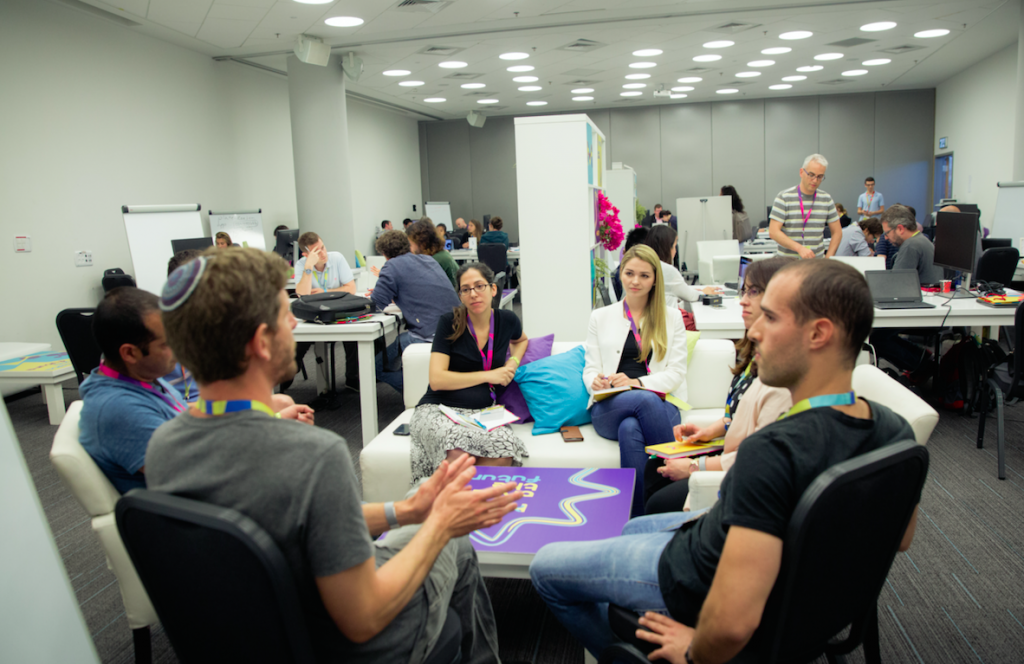
“Create the Future!” – This was the message on the colorful signs that welcomed dozens of bright, young students from Israel’s best academic institutes to the Merck Hackathon in Israel. Engineers, scientists, programmers and communications students, from undergraduate to post-doctorate, all arrived at the Tel Aviv Convention Center on May 19th, ready to spend the next 24 hours inventing, innovating, networking and, most importantly, having fun.
Following the success of the first Hackathon in Darmstadt in November 2015, the event in Israel was initiated and organized by the Innovation Center and Business Technology division, along with Merck’s team in Israel.
The Hackathon kicked off with the presentation of six challenges representing real problems that Merck employees are facing in its different departments. These were the challenges from which each team selected one to pursue:
- The first challenge required the students to come up with concepts for medical diagnostics techniques that utilize wearable sensors such as step counters, heart rate monitors and smart watches. Find a unique way to use wearable tech (smart watches, Fitbits, etc.) as medical diagnostic tools.
- The second challenge involved developing creative applications for location sensors in the workplace and in the research laboratory. Utilize GPS sensors to optimize workflow and processes in laboratories and businesses.
- The third challenge called for the students to find ideas for fighting the life-threatening problem of product counterfeiting in the drug, aerospace, agriculture and electronics industries. Tackle the growing problem of product counterfeiting threating a number of industries, such as pharmaceuticals, electronics, and agriculture.
- The fourth challenge was to find a way to digitalize chemical labs and make them smarter and more efficient. Streamline the process in chemistry labs of digitizing their research tools and data.
- The fifth challenge had the students build use-cases where “steerable” lighting devices offer improvement over current lighting devices. Improve the UI (user interface) of current lighting systems using more “steerable” technology
- The sixth challenge was to develop a smartphone application that mimics a microplate reader that will enable measuring and analyzing samples when a microplate reader is not available. Develop a smartphone app that can mimic some of the functions of a microplate reader.
Just before the competition began, Mooly Eden gave the students an inspirational speech. Mooly Eden is, according to Fortune Magazine, one of the world’s ten most brilliant technological minds.
Then the hacking began. Eleven teams took their places in the designated hacking area around tables packed with an impossible mix of items: stationary, batteries, switches, light bulbs, gauze pads, elastic bandages, duct tapes, Bluetooth devices, books, cables, pills, Raspberry Pi 3 mini-computers, and thin films. Each team was assigned a Merck employee from the relevant business area as a mentor. From dusk till dawn and beyond, the students researched their challenges, pitched and discussed each other’s concepts, designed algorithms, built devices, wrote code and conducted experiments.
When the 24 hours were up, each team presented their solution to a panel of judges made up of Merck employees and local academics. The projects were all impressive, and the judges had a difficult time naming a winner.
The third place team proposed a lighting system that could be operated by gesture for use in surgery, scuba-diving, and military missions. Second place developed a transaction-tracking system to prevent counterfeiting in the pharmaceutical industry. Two teams tied for first place! One designed an at-home kit that can test for potential allergens in food. The other designed a smartphone app that uses the flashlight as a spectrophotometer to diagnose preeclampsia.
Chen Tzur, an Electrical Engineering student from Bar-Ilan University and one of the Hackathon participants, said, “I’ve been to many Hackathons, and this one was organized excellently. I had fun and connected with a lot of amazing people. The atmosphere was great, and the food was good, too. I love these events, and this one was one of the best!”
The winning teams have been invited to present their ideas to Merck executives at the company’s Israeli R&D center in Yavne.
No Comments