

29 Oct Merck’s Green Vision
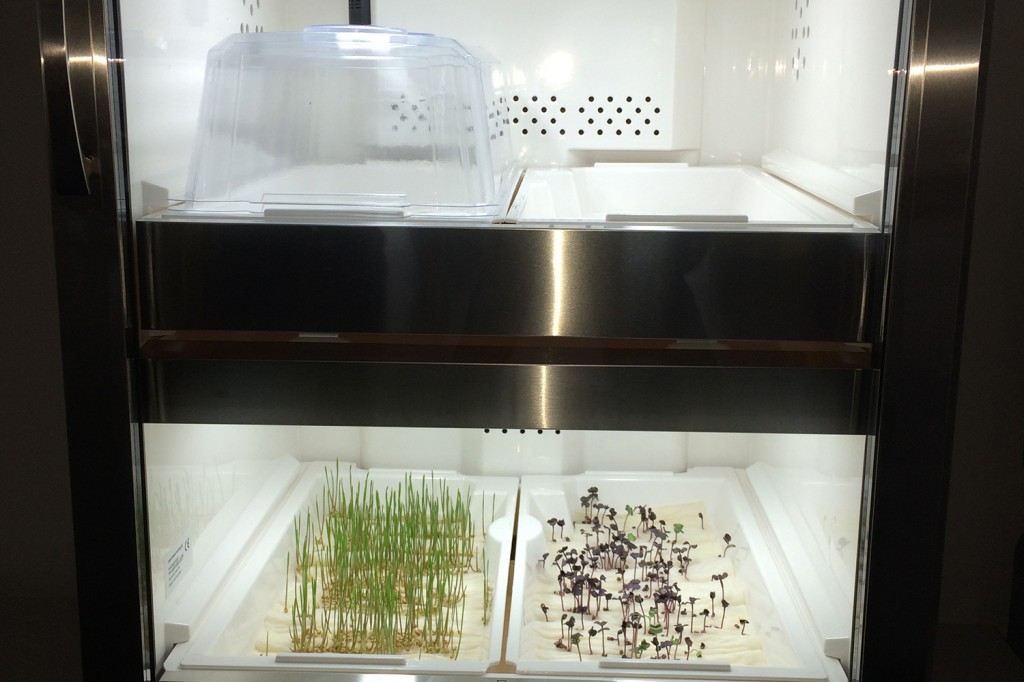
At first sight, the Merck Innovation Center and a typical greenhouse don’t have anything in common. That is, until you enter the modern building based on the company’s premises based in Darmstadt. In between conference rooms and project teams, wheatgrass and radishes are growing in abundance.
THE INNOVATION CENTER’S TRANSFORMATION INTO A GREENHOUSE
Growing vegetables in a building that focuses on technological innovation is not as strange as it might sound at first. Merck colleagues got their hands dirty as they discovered indoor farming in the think tank project. As a producer of filtration systems and novel lighting concepts with LED and OLED technologies, Merck already possesses much of know-how necessary for the technological development of indoor farming. To find out whether or not this might be relevant for Merck, the team asked for some help from external experts and talked to scientists, institutions, established companies and start-ups with an indoor farming background.

The project team successfully cultivated wheatgrass and radishes growing twice as fast than in a regular field or an ordinary greenhouse. This is due to the specially designed plant boxes, which provide the optimal conditions for the fast growth of the so-called “microgreens”. On contaminant-free surfaces, such as burlap and fleece, enriched with nutrients and kept at a constant temperature, the shoots enjoy ideal conditions. The soil is soaked twice a day to give them the necessary nutrients and water. Dependent on the type of plant, continuous or intermittent lamps provide the shoots with light, which enables them to photosynthesise in record time.
MEDICINAL PLANTS INSTEAD OF RADISHES
Indoor farming is not only important for the food industry. The technology can also be put to use for pharmaceutical manufacturing at Merck itself. Besides radishes and wheatgrass, specific medicinal plants can be cultivated indoors. Merck already produces numerous medicinal supplements, such as ointments, which are made from plant extracts sourced from overseas, especially India. So far, the supply and the gain from these extracts are heavily dependent on the weather and the quality of the soil where they are grown. With vertical farming, a sub form of indoor farming, where plants are stacked one above the other on many different levels, irregularities in the form of supply and the quality of the medicinal plants can soon belong to the past. Because even in the Rhine-Main region, plants can then be kept in good quality soil and the perfect temperature due to the installation of these extensive indoor farming systems. It remains unclear if Merck will start big scale indoor farming projects. So far the Think Tank is a creative hub that enriches the idea finding process at Merck and brings big and small ideas to live.
No Comments